
Some of the most memorable moments in Ireland are not the big postcard views. They are the things you hear across a pub table, the stories told on a coastal road, the sound of a fiddle starting up in a village bar, or the quiet feeling of standing where people have gathered for thousands of years. That is why the best Ireland cultural experiences are rarely about rushing from landmark to landmark. They are about being in the right place, at the right pace, with enough room to actually take it in.
For many visitors, especially on a first trip, culture is what turns a beautiful vacation into a meaningful one. Ireland has no shortage of castles, cliffs, and famous sights, but the country makes its strongest impression through people, place, language, music, and memory. If you want your trip to feel distinctly Irish rather than simply scenic, these are the experiences worth building around.
What makes the best Ireland cultural experiences feel authentic
Authenticity in Ireland is not usually a staged performance. More often, it is a guide who knows the local history and the local characters, a family-run restaurant where the conversation matters as much as the meal, or a village where the pub is still a social center. That can make planning a little tricky. The best moments are not always the ones with the biggest ticket booth or the most polished visitor center.
It also depends on what kind of traveler you are. Some people want deep heritage and archaeology. Others want music, literature, food, or connections to family history. The strongest itineraries mix a few headline cultural experiences with time for the smaller, more personal ones that happen naturally along the way.
1. Traditional music sessions in the right setting
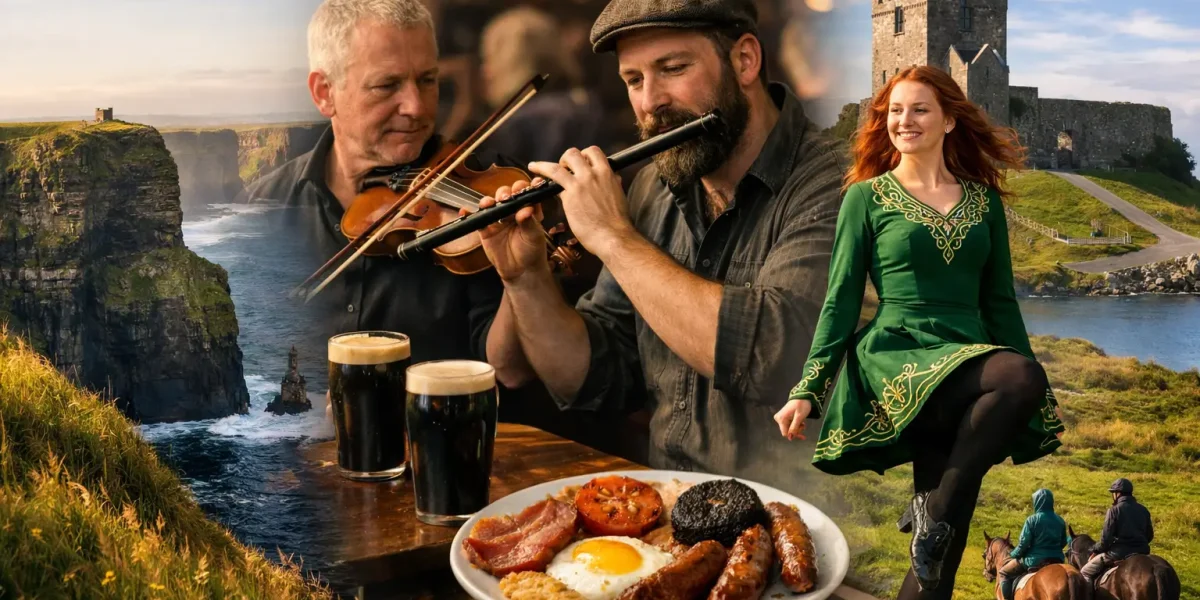
A traditional music session is one of the great pleasures of traveling in Ireland, but not all sessions feel the same. Some are arranged for visitors, and some are simply part of local life. Neither is automatically better. If you are new to Irish music, a lively session in Galway, Dingle, or Westport can be a brilliant introduction. If you want something more intimate, smaller towns often offer a richer sense of place.
The magic is in the atmosphere. Musicians may sit in a corner rather than on a stage. Tunes flow one into the next. There is often no formal start or finish. You are not just listening to music. You are watching a tradition being carried in real time.
2. Storytelling where the landscape still matters
Ireland is a country of storytellers, and the best storytelling experiences are tied to the land itself. On the west coast, in Donegal, Connemara, Kerry, and Clare, stories still feel rooted in the roads, fields, islands, and headlands around you. A ruined abbey, an old famine road, or a standing stone becomes much more powerful when someone gives it context with wit and local memory.
This is where a private touring style has a real advantage. You can stop when a place catches your attention instead of hearing history through a coach microphone while the bus keeps moving. The story has time to land.
3. Visiting ancient sites beyond the obvious
Newgrange deserves its reputation. So does the Rock of Cashel. But some of the best Ireland cultural experiences happen at lesser-known early Christian sites, ring forts, high crosses, monastic ruins, and passage tombs where the setting still feels undisturbed.
Ireland’s ancient sites are not only old. They show continuity. Pagan landscapes, early Christianity, Norman influence, and later political history all overlap in ways that make the country unusually rich for travelers who enjoy context. The trade-off is that some smaller sites have fewer facilities and less interpretation. They reward travelers who value atmosphere over polish.
4. Gaelic games with local pride attached
If you want to understand modern Irish identity, spend time learning about Gaelic football and hurling. These are not just sports. They are expressions of county pride, local loyalty, and community life. Even visitors with little interest in athletics often come away impressed by the passion around them.
A live match is ideal, but even a conversation with a guide or local host about rivalries, traditions, and the role of the GAA can add a layer of understanding to your trip. It gives you a window into Ireland that many standard sightseeing itineraries miss.
5. Literary Ireland in Dublin and beyond
Dublin’s literary heritage is world-famous, and rightly so. Joyce, Yeats, Beckett, Wilde, and Heaney all help shape the city’s intellectual identity. But literary Ireland does not stop in the capital. County Sligo has Yeats country written across its landscapes. Belfast carries the energy of poetry, politics, and modern cultural reinvention. Small bookshops, theaters, and historic houses often tell the story better than any broad overview can.
For some travelers, this is one of the most rewarding cultural threads to follow because it connects so naturally with place. You are not just reading about the writers. You are seeing the streets, coastlines, and hills that informed the work.
6. Food experiences that tell a local story
Irish food has changed dramatically in the last two decades. Anyone arriving with dated ideas about heavy meals and little else is usually pleasantly surprised. The most interesting food experiences now combine tradition with regional pride, whether that means seafood on the Atlantic coast, farmhouse cheeses, soda bread, oysters, whiskey, or beautifully prepared local lamb.
The best approach is not to chase trendy restaurants alone. A great lunch in a small town, a tasting with a producer, or dinner in a trusted local spot often says more about Irish culture than a formal tasting menu. Food works best as part of the day’s journey, not as a disconnected event.
Best Ireland cultural experiences for heritage travelers
For American visitors with Irish ancestry, heritage travel often begins with records and family names, but the emotional impact usually comes from place. Walking the streets an ancestor may have known, visiting a parish, or simply spending time in the county your family came from can feel far more personal than a document search alone.
This is where expectations matter. Not every family trail leads to a dramatic discovery. Sometimes the most meaningful part is understanding the environment your people left behind – the farming conditions, the geography, the village structure, the scale of emigration. A thoughtful heritage experience should leave room for both facts and feeling.
7. Irish language and Gaeltacht culture
Hearing Irish spoken in a Gaeltacht area changes the way many visitors understand the country. It reminds you that Ireland’s identity is not just scenic or historical. It is linguistic and living. Areas in Galway, Kerry, Donegal, and elsewhere still maintain strong Irish-speaking traditions, though daily life varies from place to place.
This is not about needing to speak the language yourself. It is about recognizing another layer of Irish culture that survives beyond symbolism. Road signs, local expressions, songs, and place names all take on more meaning once you encounter the language in context.
8. Craft traditions with real local roots
Irish weaving, pottery, jewelry, instrument-making, and textile work can be far more interesting than standard souvenir shopping. In the right setting, meeting makers and seeing craft connected to local materials and regional design gives you a stronger sense of continuity between past and present.
The key is curation. Some shops are purely commercial, while others genuinely reflect local skill and heritage. If you care about quality, it helps to be guided toward workshops and galleries with substance behind them.
9. Belfast’s political and cultural story
Belfast offers one of the most layered urban cultural experiences in Ireland. Its shipbuilding history, music scene, literary talent, street art, and political past all sit close together. The city’s story can be challenging at times, but that is part of why it matters.
Handled well, Belfast is not a stop defined only by conflict. It is a city that shows resilience, creativity, and change. For travelers who want a fuller understanding of the island, it deserves proper time.
10. Festivals and seasonal traditions
Ireland’s calendar still carries strong seasonal character. St. Patrick’s Day gets the headlines, but smaller festivals often offer the more satisfying experience. A local arts festival, food gathering, traditional music weekend, or horse fair can make a trip feel distinctive in a way that fixed attractions cannot.
The trade-off is planning. Festivals can mean busy roads and limited accommodations. But if your dates line up well, they can bring a whole region to life.
11. Sacred spaces and quiet moments
Not every cultural experience needs a performance or a crowd. Some of Ireland’s strongest cultural impressions come in abbeys, graveyards, pilgrimage sites, and old churches where the history feels settled into the stone. These places often speak most clearly when there is time and stillness.
For travelers who enjoy reflection, they can balance the busier parts of an itinerary beautifully. A trip does not need to be packed every hour to feel full.
12. Conversations that were never on the itinerary
This may be the most overlooked cultural experience of all. Ireland is a country where conversation still carries real social value. The chat with a shopkeeper, the driver with perfect comic timing, the guide who connects family history to a hillside, the restaurant owner who steers you toward the right dish – these moments are not extras. They are often the heart of the trip.
That is one reason private travel suits Ireland so well. Flexibility allows for detours, longer lunches, unscheduled stops, and the sort of local interaction that mass touring tends to flatten. Creagh Travel builds itineraries around that kind of ease, where the day can breathe and the country has room to introduce itself properly.
If you want Ireland to feel more than scenic, leave space for culture to happen in its natural setting. The best memories are usually the ones that felt unforced when they happened, and impossible to forget afterward.